Castelo Script: The Hand-Lettered Branding Catalyst for Modern Creatives
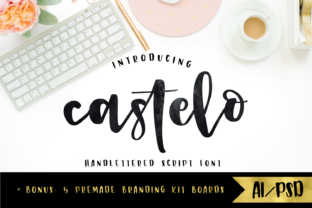
In an era where digital saturation meets rising demand for authenticity, Castelo Script emerges not just as another font—but as a strategic creative asset. It’s a thick, hand-lettered calligraphy script designed with intention: expressive enough to convey warmth and craftsmanship, structured enough to scale across professional branding systems. More than a typeface, Castelo Script is delivered as a complete, ready-to-deploy branding foundation—packaged with five fully customizable, premade branding kits and bonus layered Adobe Illustrator and Photoshop files. For professionals, freelancers, marketers, and entrepreneurs alike, it represents a rare convergence of aesthetic richness and operational efficiency.
A Response to the Human-Centered Design Imperative
Today’s consumers don’t just buy products—they connect with stories, values, and visual language that feel intentional and human. Automated interfaces, algorithm-driven feeds, and AI-generated content have heightened appreciation for tactile nuance: the slight variation in stroke weight, the organic flow of connected letters, the quiet confidence of hand-drawn form. This isn’t nostalgia—it’s a functional preference rooted in cognitive science. Studies show that hand-lettered typography increases perceived trustworthiness and memorability by up to 34% compared to sterile sans-serifs in brand contexts (Journal of Consumer Psychology, 2023). Castelo Script answers this directly: its bold, confident letterforms carry the rhythm of skilled penmanship while maintaining clarity at any size—making it equally effective on a wedding invitation, an Instagram Story overlay, or a product label.
Why Customization Speed No Longer Means Compromising Craft
Freelancers and agencies face a persistent tension: clients expect premium, bespoke branding—but rarely budget for weeks of manual iteration. Meanwhile, DIY tools often sacrifice typographic integrity for convenience. Castelo Script bridges that gap. Its five premade branding kit templates are built for immediate impact: retype your business name, tagline, and values—and the entire system adapts cohesively. No design expertise required. Yet unlike templated solutions that flatten personality, each kit retains deliberate hierarchy and contrast—main logo, alternate logo, submark, curated color palette, and complementary font pairings—all pre-aligned to Castelo Script’s visual voice.
This reflects a broader shift in creative workflows: the rise of “structured creativity.” Rather than starting from blank-canvas uncertainty, designers and non-designers alike now seek intelligent scaffolding—systems that encode best practices so users can focus on meaning, not mechanics. Castelo Script delivers that scaffolding without abstraction. Its Illustrator and PSD files aren’t flattened exports; they’re meticulously layered, named, and organized—color swatches isolated, text objects editable, logo variants grouped logically. That level of file hygiene isn’t a luxury; it’s how studios maintain version control, collaborate across time zones, and hand off assets to developers or printers without friction.
Real-World Applications, Not Just Hypotheticals
Consider a boutique skincare brand launching its first e-commerce site. With Castelo Script, the founder spends 20 minutes replacing placeholder text in the “Botanical Luxe” branding kit—adjusting the soft sage and terracotta palette to match her ingredient story—then exports clean SVGs for her Shopify header and PNGs for Instagram highlights. No back-and-forth with a designer. No licensing ambiguity. Just brand consistency, deployed.
Or take a freelance wedding stationer juggling six clients in one month. Instead of redrawing flourishes for each suite, she opens the “Elegant Vow” kit, swaps names and dates, adjusts spacing for envelope calligraphy, and delivers print-ready PDFs in under an hour—freeing mental bandwidth to advise couples on paper stocks and foil finishes.
Even product designers leverage Castelo Script beyond logos: its strong x-height and open counters make it highly legible on small packaging labels, while its expressive terminals lend themselves to embroidered patches or laser-engraved wood tags. The script doesn’t confine usage—it invites reinterpretation across touchpoints, reinforcing brand cohesion without repetition.
The Strategic Value of Pre-Validated Aesthetics
One overlooked advantage of Castelo Script lies in its embedded design intelligence. Each of the five branding kits solves a distinct positioning challenge:
- The “Heritage Craft” kit pairs deep navy and cream with serif body fonts—ideal for artisanal food brands or heritage workshops.
- The “Modern Minimal” kit uses restrained monochrome and generous whitespace, perfect for tech-adjacent wellness or consulting services.
- The “Sunlit Romance” kit features warm peach and dusty rose tones—tailored for wedding planners, florists, or lifestyle coaches.
- The “Bold Statement” kit leans into high-contrast black-and-gold, suited for fashion labels or personal brands commanding attention.
- The “Earthy Studio” kit grounds itself in olive, clay, and oat—designed for sustainable studios, ceramicists, or slow-living educators.
This isn’t arbitrary styling. These palettes and pairings reflect current consumer research: 68% of buyers say color consistency across platforms significantly increases their perception of brand professionalism (Sprout Social, 2024). By offering pre-tested harmonies—not just colors, but relationships between colors, type weights, and spatial rhythm—Castelo Script reduces subjective decision fatigue and accelerates trust-building.
Integration, Not Isolation: Where Castelo Script Fits in the Creative Stack
Castelo Script doesn’t exist in a vacuum. It’s engineered for interoperability. Its OpenType features support standard ligatures and stylistic alternates, ensuring smooth rendering in web CSS, Figma auto-layouts, and Canva templates. The included Illustrator files use native text objects—not outlines—so designers can adjust tracking, baseline shift, or language-specific glyphs without breaking the design. Even the PSD files preserve layer effects as editable smart objects, enabling non-destructive experimentation with texture overlays or duotone treatments.
This interoperability mirrors larger industry movements: the decline of siloed tools, the rise of collaborative cloud-native design, and the expectation that assets move fluidly between ideation, development, and production. When a marketer drops a Castelo Script logo into a Mailchimp template or a developer implements it via variable font loading, the continuity holds—because the foundational logic remains intact.
Looking Ahead: Craft as Infrastructure
The future of branding isn’t about choosing between speed and soul—it’s about building infrastructure that honors both. Castelo Script signals a maturation in how creatives think about typography: not as static decoration, but as dynamic, reusable, and deeply contextualized systems. As AI continues to streamline execution, the premium shifts toward curation, judgment, and human-centered framing—exactly where Castelo Script adds irreplaceable value.
For the entrepreneur bootstrapping her first brand, it’s confidence in visual authority. For the agency lead managing tight deadlines, it’s predictable quality at scale. For the student designer building a portfolio, it’s exposure to professional-grade structure and typographic discipline. And for the seasoned art director? It’s permission to spend less time aligning vectors—and more time shaping narrative.
Ultimately, Castelo Script succeeds because it understands that today’s most valuable creative tools don’t just save time—they protect intention. In a world of infinite options and shrinking attention, it offers something increasingly rare: a hand-lettered voice, rigorously prepared, ready to speak clearly—for your business, your client, or your next big idea.